

Crawl Space Door Replacement in Charleston SC: Cost, Code, and Keeping Animals Out
What crawl space door replacement costs in Charleston SC, door types compared, flood and code rules, plus a free cost calculator. Just an estimate.
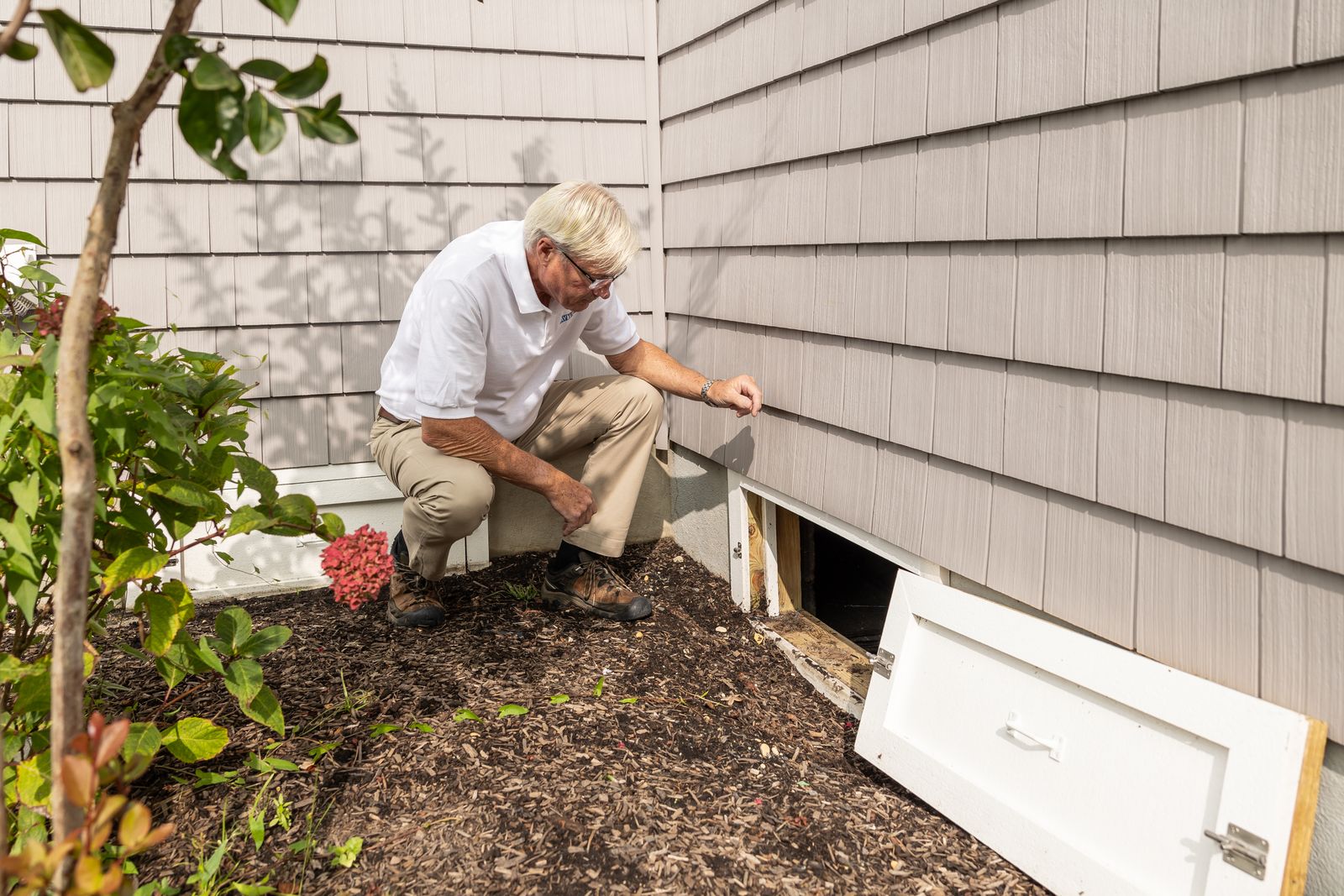
The crawl space door is the biggest single opening in the foundation of a raised Lowcountry home, and it is the one most people never think about until it fails. By the time someone calls us, the door is usually rotted along the bottom, hanging off one hinge, or sitting in the dirt a few feet from the hole. And something has been coming and going underneath the house.
This guide covers what crawl space door replacement actually costs in the Charleston area, how the door types compare, what South Carolina code and Charleston flood rules require, and why a busted door is an open invitation for wildlife. There is a calculator below so you can estimate your own job in about a minute. Read the flood zone section before you buy anything, because across much of Charleston a solid door on its own is not legal.
Signs You Need to Replace Your Crawl Space Door
Replace your crawl space door when it is rotted, warped, cracked, will not latch, leaves a gap, lets water or humid air in, or is missing entirely. Any one of those turns the largest hole in your foundation into a doorway for animals and moisture. A door that no longer seals is doing none of its three jobs: keeping animals out, keeping the right amount of air moving, and keeping water where it belongs.
Here is what we look for on an inspection:
- Rot or soft spots, especially along the bottom rail where the door meets damp soil. Untreated wood doors are the usual culprit because they swell, warp, and crack in Lowcountry humidity.
- A door that no longer latches or sits flush. A gap of half an inch is all a rat needs.
- Rust and bent louvers on old galvanized vent doors, which stop closing and let animals push past.
- Daylight, drafts, or standing water visible from inside the crawl space around the frame.
- Chew marks, dig marks, or a door knocked clean off, which means an animal has already been testing it or using it.
- No door at all, just an open hole or a piece of plywood leaned against the foundation. We see this more often than you would think.
If you are hearing noises under the floor or smelling something musty inside the house, the door is often only the symptom. It is worth reading what actually happens after an animal has been living in your crawl space before you assume a new door ends the problem.
How Much Does Crawl Space Door Replacement Cost in Charleston?
Crawl space door replacement in Charleston typically runs about $300 to $800 for a simple swap into a sound, correctly sized opening, and roughly $600 to $1,700 for a standard door professionally installed. The door itself costs anywhere from about $25 to $800 depending on the material. Cutting or enlarging an opening, repairing rotted framing, adding a vapor barrier, or installing flood vents all push the number higher.
Four things drive the price:
- The door material. A snap-in plastic vent is a few dollars. A sealed insulated access door is several hundred. See the comparison table below.
- The opening. A clean swap into a good masonry opening is quick. Cutting a new opening in a block foundation, or enlarging one to meet code, runs roughly $400 to $900 in extra labor on its own.
- What the old door hid. Rotted framing around the opening, a torn vapor barrier, or animal contamination are separate jobs, and they are common in older Charleston homes.
- Flood requirements. In a flood zone the door has to work alongside compliant flood vents, which adds material and labor.
Here is how the common options price out, product only, based on current retail from Home Depot, Lowe's, and the specialty door makers:
| Door type | Product price (door only) | Best for |
|---|---|---|
| Plastic louvered foundation vent | $7 to $40 | Cheap ventilation, not real security or exclusion |
| Galvanized or steel access door | $23 to $98 | Budget swaps; rusts over time in coastal humidity |
| ABS plastic access door | $140 to $250 | Rot proof, low maintenance, the practical standard |
| Insulated airtight door | $200 to $540 | Sealed and encapsulated crawl spaces |
| Engineered flood vent (pairs with a door) | $215 to $260 | Required openings in flood zones |
| Custom or composite PVC door | $186 to $275 retail, $600 and up installed | Oversized or made to fit |
A note on local quotes: most Charleston crawl space and encapsulation companies do not sell a door swap on its own. They bundle it into a larger repair and quote it after an in-home visit. That is fine, but it makes it hard to know what you are actually paying for the door. For a sense of how wildlife jobs are priced more broadly, our Charleston wildlife removal cost guide breaks the ranges down by situation. You usually do not need a permit to replace a door in an existing opening, but you do need one to cut a new opening.
Estimate Your Cost: Crawl Space Door Price Calculator
We build and install custom wooden (plywood) crawl space doors, made to fit your exact opening. Use the calculator to get a ballpark for your own home: pick the opening size and whether the frame needs work. Most of our crawl space door jobs run $400 to $900, with about $600 average. It is an estimate to help you plan, not a quote, and the real number always comes from an inspection.
Crawl Space Door Replacement Cost Calculator
We build and install custom wooden (plywood) crawl space doors, made to fit your exact opening. Pick the size that matches your crawl space for a ballpark price. It is an estimate, not a quote.
- Custom wooden door, installed (standard opening)$400-$600
Most of our crawl space door jobs run $400 to $900, with about $600 average.
Crawl Space Door Types and Materials Compared
The right crawl space door depends on your climate, your foundation, and whether you are in a flood zone. In the Lowcountry, the two failures that matter most are rot and rust, so the real choices come down to a properly built and sealed wooden door, ABS plastic, composite PVC, or a sealed insulated door. The one thing to avoid is raw, untreated wood, which rots fast in our humidity. Here is the honest comparison:
| Type | Material | Pros | Cons |
|---|---|---|---|
| Plastic louvered vent | Plastic resin or ABS | Cheapest, will not rot or rust | Tiny, snaps out, not real exclusion |
| Galvanized steel access door | Steel with built-in screen | Cheap, rigid, has insect screen | Rusts in coastal humidity, louvers bend |
| Custom wooden (plywood) door | Treated or exterior-grade plywood, sealed | Made to fit any opening, cost-effective, easy to repair or replace, what we build | Has to be built from treated plywood and sealed well, or it rots |
| ABS plastic access door | UV protected ABS | Rot proof, rust proof, low upkeep | Not insulated unless upgraded, stock sizes only |
| Insulated airtight door | ABS or aluminum with foam core | Seals the opening, fits encapsulated crawl spaces | Costs more, wood-core versions can still rot |
| Engineered flood vent | Marine grade stainless | FEMA compliant, opens under flood pressure | A vent, not a door; it works with a door |
| Custom or composite PVC | Solid PVC or composite | Longest life, tailored fit, waterproof | Highest cost |
For a vented crawl space, the door and the vents are doing real work moving air. For a sealed or encapsulated crawl space, which is the better long-term answer in our humidity, the door becomes part of an airtight envelope and an insulated model makes sense.
How to Replace a Crawl Space Door (and How to Measure)
Most crawl space doors are wall mounted over the foundation opening, not floor hatches, so replacement is mostly about getting the measurement and the seal right. Measure the rough opening, then order a door with a frame that overlaps it. Specialty prefab doors usually want at least three and a half inches of clearance around the whole opening, with the outer frame running about six inches larger than the hole.
The basic sequence:
1. Measure the opening at the widest and tallest points, and check that it is square. Old masonry openings rarely are.
2. Remove the old door and frame, and clear out rot, loose mortar, and debris.
3. Check the framing and sill. If the wood around the opening is soft, that gets repaired first. A new door bolted to rotted framing does not last.
4. Set and fasten the new frame, level and plumb, anchored into masonry or pressure treated framing.
5. Seal the perimeter so there is no gap, and back any vent openings with hardware cloth.
6. Hang and latch the door, and confirm it closes tight with no daylight around the edges.
A clean swap into a sound, correctly sized opening is often a one to three hour job. Cutting masonry, repairing framing, or fitting a custom size turns it into a half or full day. The video below walks through replacing an old crawl space access panel from start to finish:
Building Code for Crawl Space Doors in South Carolina
South Carolina enforces the 2021 International Residential Code (adopted as the 2021 South Carolina Residential Code), which took effect statewide on January 1, 2023. Two parts of that code shape your crawl space door: the access requirement and the ventilation requirement.
Under Section R408.4, a crawl space access opening must be at least 18 inches by 24 inches when it goes through the floor, and at least 16 inches by 24 inches when it goes through a perimeter wall, which is the typical foundation access in Charleston. A through-wall opening cannot be placed under a door to the house, and a below-grade opening needs an areaway at least 16 inches by 24 inches. If your existing opening is smaller than code, replacing the door is the moment to enlarge it, which is the line item that adds the most labor.
For a vented crawl space, Section R408.2 requires net ventilation of at least one square foot of opening for every 150 square feet of crawl space, with one vent within three feet of each corner. That ratio drops to one square foot per 1,500 square feet only when two conditions are both met: the ground is covered with an approved Class I vapor retarder, and the openings are placed to provide cross ventilation. Section R408.3 lets you eliminate the vents entirely in a properly conditioned or encapsulated crawl space, which is why so many Lowcountry homes are moving to sealed crawl spaces with an insulated door instead of louvered vents.
Flood Zone Rules: Why a Solid Door Can Be Illegal in Charleston
In Charleston's flood zones, a solid airtight crawl space door by itself is not code compliant. Most of the peninsula and the surrounding low areas sit in Special Flood Hazard Areas, mapped by the City of Charleston as AE, Coastal A, and VE zones. In those zones, FEMA and the National Flood Insurance Program require the enclosed crawl space to have flood openings that let water flow in and out, so the foundation is not destroyed by water pressure during a storm.
The federal rule (44 CFR 60.3) is specific: a crawl space in an A zone needs at least one square inch of net open area for every square foot of enclosed floor area, a minimum of two openings on at least two different walls, and the bottom of each opening no higher than 12 inches above grade. Each opening has to be at least three inches across. FEMA's Technical Bulletin 1 is blunt that a solid door, or a vent you have to open by hand, does not count as a flood opening, because it cannot equalize water pressure on its own.
This matters for two reasons. First, if your openings do not comply, FEMA can treat the crawl space floor as the home's lowest floor for rating, which can raise your flood insurance premium sharply. Second, in V and VE zones the rules are stricter still, and the area below the house generally has to use breakaway walls, lattice, or screening rather than solid enclosure. The fix is to pair a proper access door with engineered flood vents (the stainless Smart Vent type, carrying an ICC-ES report, which Charleston requires as permit documentation). Those vents are also a wildlife entry point, so they have to be screened in a way that still pops open under flood pressure. If you are not sure of your zone, the city's Know Your Flood Zone tool will tell you.
Who Installs Crawl Space Doors in Charleston?
A crawl space door is installed by handymen, foundation and encapsulation contractors, and wildlife exclusion companies, and which one you want depends on why the door failed. If the door is just old, any competent installer can swap it. If the door failed because an animal tore it off, or if you are replacing it to keep animals out, the install needs to be done as exclusion work, not just carpentry.
That is the part most installers miss. We build custom wooden crawl space doors to fit your opening and install them as part of our crawl space services, which means the door is fitted tight, the perimeter is sealed, every vent and gap is backed with the right hardware cloth, and the rest of the foundation is checked for the other openings animals use. A new door on a house that still has a dozen open gaps along the foundation just sends the raccoon to the next hole. For full encapsulation or major structural repair we coordinate with trusted specialists, but the sealing and exclusion is our core work.
Keeping Wildlife Out: Why Door Integrity Matters in the Lowcountry
A broken or missing crawl space door is one of the easiest ways for wildlife to get under a raised home, and the gap sizes that matter are small. The CDC notes that a house mouse can fit through a hole the width of a pencil, about a quarter inch, and the University of California's pest guidance is that rats can squeeze under a door with only a half inch gap, so you seal anything larger than a quarter inch. That is why a real exclusion door is fitted tight, latched, sealed at the perimeter, and backed with galvanized hardware cloth (half inch mesh to stop rats, quarter inch to stop mice), which is the opposite of a flimsy louvered vent that warps and pops out.
Opossums and raccoons are the most common animals denning in Charleston crawl spaces, roof rats and Norway rats are in them year round, and snakes follow the rodents in (South Carolina has around 38 snake species, six of them venomous, per Clemson). Armadillos, which are spreading through Dorchester and Berkeley counties and onto Johns Island, dig burrows seven to eight inches across right along foundations. A failed door makes all of that easier. If you have already found a visitor, our guides on an opossum in your crawl space and the gaps roof rats use to get in cover what comes next. And because Charleston's high water table keeps crawl space humidity high, a door that seals also helps hold the space below 60 percent relative humidity, the threshold where mold takes off. Raised homes are a particular target, which is its own Lowcountry problem worth understanding.
Frequently Asked Questions
Do I need a permit to replace a crawl space door?
Usually not. Replacing a door in an existing opening is treated as a repair and does not typically require a permit. You do need a permit to cut a new opening or enlarge an existing one, and in a flood zone you need permit documentation (an ICC-ES report) for engineered flood vents. When in doubt, the City of Charleston building office can confirm for your address.
Will a solid crawl space door work in a flood zone?
No, not on its own. In Charleston's AE, Coastal A, and VE flood zones, FEMA rules require flood openings that let water flow through the crawl space, at least one square inch per square foot of enclosed area on two walls. A solid door has to be paired with engineered flood vents. A solid door alone can violate code and raise your flood insurance.
Plastic, steel, wood, or insulated: which crawl space door is best?
The things to avoid are raw, untreated wood, which rots, and bare galvanized steel, which rusts in coastal humidity. A custom door built from treated, sealed plywood is a sound, cost-effective choice, made to fit your exact opening, and it is what we build. ABS plastic and composite PVC are low-maintenance alternatives, and an insulated airtight door suits a sealed or encapsulated crawl space.
What size does code require for a crawl space access opening?
Under South Carolina's 2021 Residential Code (Section R408.4), an access opening through the floor must be at least 18 inches by 24 inches, and an opening through a perimeter wall must be at least 16 inches by 24 inches. If your current opening is smaller, replacing the door is the right time to enlarge it to code.
Can I replace a crawl space door myself?
A like-for-like swap into a sound, correctly sized opening is a reasonable DIY job if you can measure accurately and seal the perimeter well. It stops being a DIY job once there is rotted framing, masonry that needs cutting, flood vent requirements, or signs that an animal has been getting in, because at that point the door is part of a larger exclusion and moisture problem.
How long does a crawl space door last?
It depends entirely on the material. An untreated wood door may last only a few years in Charleston humidity before it rots. Galvanized steel rusts over time. ABS plastic, composite PVC, and stainless flood vents can last decades because they do not rot or rust. The seal and the latch usually fail before a quality door body does.
Call (843) 212-1147 to schedule an inspection and a real quote for your crawl space door.
Crawl Space Services
Exclusion-grade crawl space door replacement and sealing, vent screening, vapor barriers, and full cleanup after wildlife. Serving Charleston, SC.
See our crawl space services